
How to Load and Haul a Car on a Tilt Car Hauler (Even If It Won't Start)
Maybe you found the right car on Marketplace two hours away. Maybe a project car has been sitting in a garage for years and it is finally time to move it. Either way, you are about to haul a car yourself, and you want it to arrive in the same shape it left in.
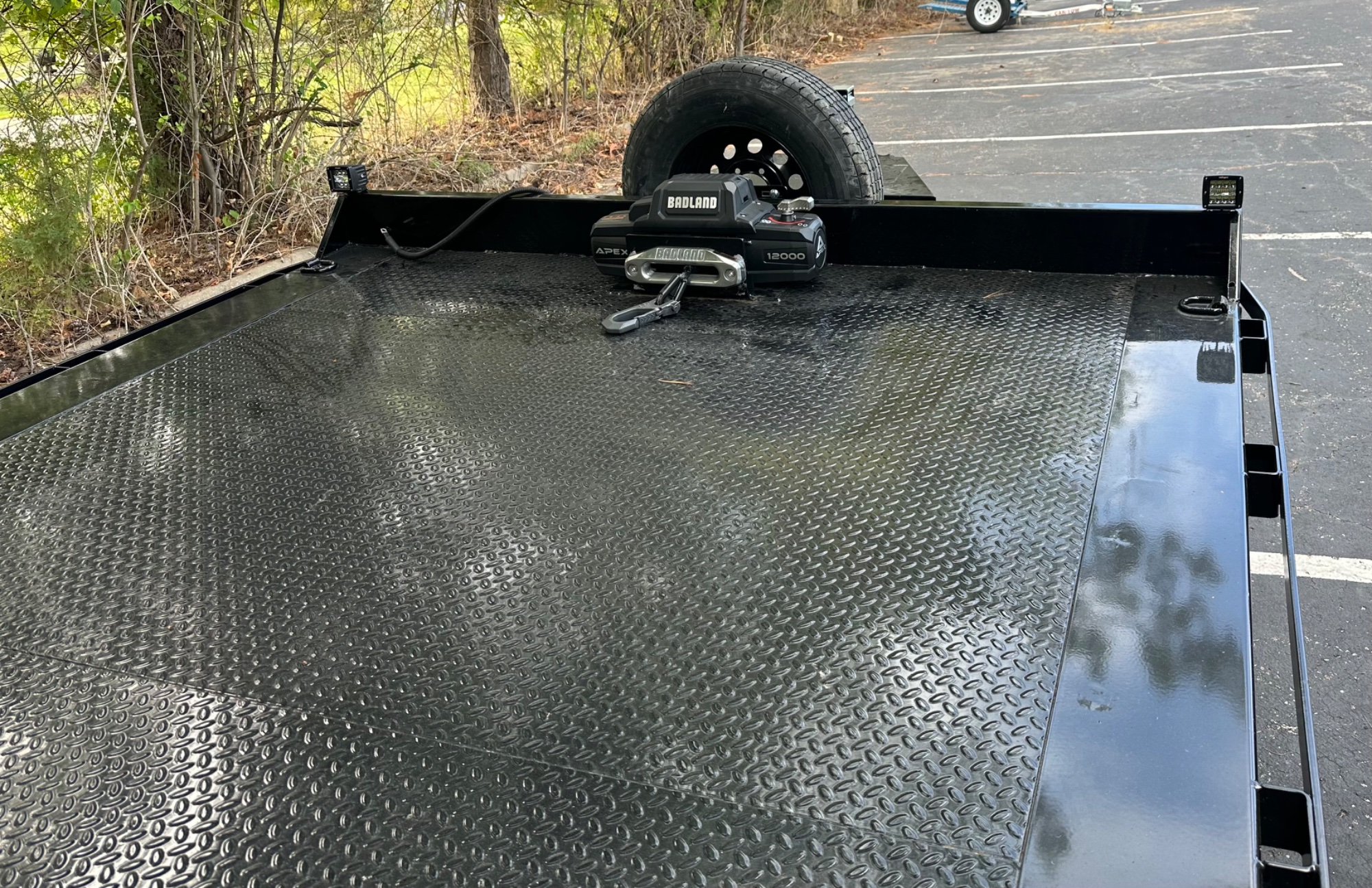
This guide is built around our 22' MAXX-D car hauler, a tilt-deck trailer with a 12,000 lb Badland APEX winch. The same ideas apply to most car haulers, but tilt decks load a little differently, so read the loading section even if you have towed before.
Before you leave home
- Know what the car weighs. Look up its curb weight. Add the trailer, and make sure the total is within your truck's towing rating. If you are not sure, text us both vehicles and we will help with the math.
- Check your hitch. The trailer takes a 2-5/16" ball. A 2" ball can look close enough and still pop off on a bump. Check the size stamped on top of the ball.
- Check your plug and brakes. The trailer uses a round 7-pin plug, which is how trailer brakes get their signal. Your truck needs a 7-pin socket and a working brake controller. A 4-flat adapter runs the lights but not the brakes.
- Bring gloves and a flashlight. You will be handling the winch line and straps, possibly in a dark driveway.
How a tilt deck works
On a tilt car hauler, the front section of the trailer stays fixed and the main deck pivots near the axles. When you release the tilt latch, the back of the deck lowers to the ground and becomes its own ramp. As the car moves forward past the pivot point, the weight tips the deck back down level. Then you lock it.
That means no loose ramps to carry, line up, or kick out from under a tire. It also means the order of steps matters. At pickup we will show you the tilt latch on this trailer in person, so you have seen it done before you do it alone.
Loading a car that runs
- Park straight. Truck and trailer in a straight line on level ground, truck in park, parking brake set.
- Release the tilt and let the deck down. Make sure no one is standing near the back of the deck or beside the pivot.
- Line the car up square to the deck. Have a spotter stand off to the side, never behind the car or in front of the trailer.
- Drive up slowly and steadily. No bursts of throttle. As the car passes the pivot, the deck will settle level.
- Stop with the engine toward the front. Roughly 60 percent of the car's weight should sit ahead of the trailer axles. That puts the right amount of weight on your hitch and keeps the trailer from swaying.
- Lock the tilt. Do not skip this step, and do not move until it is done.
Loading a car that does not run
This is what the winch is for. With the deck tilted down, run the winch line out to a solid towing point on the car's frame or a factory tow hook. Do not hook to suspension parts, tie rods, or bumpers.
- Put the car in neutral, and have someone in the driver's seat to steer if the steering works.
- Stand to the side of the winch line, never in line with it, and run the winch with the remote.
- Pull the car up slowly. Watch the deck settle level as the weight passes the pivot.
- Once the car is in position, set its parking brake, lock the tilt, and only then start strapping.
Safety: Never stand in line with a loaded winch line, and never put any part of your body under a tilting deck. A winch line under load can snap back hard, and a deck can move with very little warning. If something does not look right, stop, slack off the line, and call us.
Tying it down
The winch is not a tie-down. Once the car is loaded, strap it down at all four corners as if the winch were not there.
- Use four straps, one at each corner, pulling outward and slightly forward or back, so the car cannot move in any direction.
- Strap the tires or the frame, not the suspension. Wheel straps over the tires let the car's suspension work normally while the tires stay locked to the deck.
- Snug, not crushing. Tighten until the car does not rock, then stop.
- Tuck the loose tails so they cannot flap against paint or get caught in a wheel.
On the road
Pull over after the first few miles and check every strap. Straps settle as the load settles, and that first check catches almost every problem. Check again at every fuel stop.
Leave a lot more following distance than usual, take turns wider, and give yourself extra room to slow down for hills. Coming home on I-70 from the west, the rolling hills between Columbia and Wentzville are where you notice the extra weight most.
Picking up a car from out of town
We rent a lot of car haulers for one-day pickups. Here is roughly how long the drive takes one way from St. Peters, so you can decide between a one-day and two-day rental:
- Columbia, MO: about 1.5 hours
- Springfield, IL: about 1.5 to 2 hours
- Kansas City: about 3.5 hours
- Springfield, MO: about 3.5 hours
- Indianapolis: about 4 hours
- Chicago: about 5 hours
Anything past about three hours each way, plus loading time, is a long day. A two-day rental takes the pressure off and keeps you from rushing the tie-down to make the return time.
Before you drive out, ask the seller to send a photo of the car's tow points and confirm whether it rolls and steers. A car with a locked brake or flat tires changes the plan, and it is better to know in St. Peters than in someone else's driveway.
Questions about a specific car? Call or text 314-866-0009.