
Can My Truck Tow It? A Firefighter's Pre-Trip Checklist for Renting a Trailer
Joshua, who owns Burn the Ships, has spent 13 years as a full-time firefighter and decades pulling trailers, including tractor-trailers with a Class A license. Both jobs teach the same lesson: the problems you catch in the driveway are the ones that never become problems on the highway.
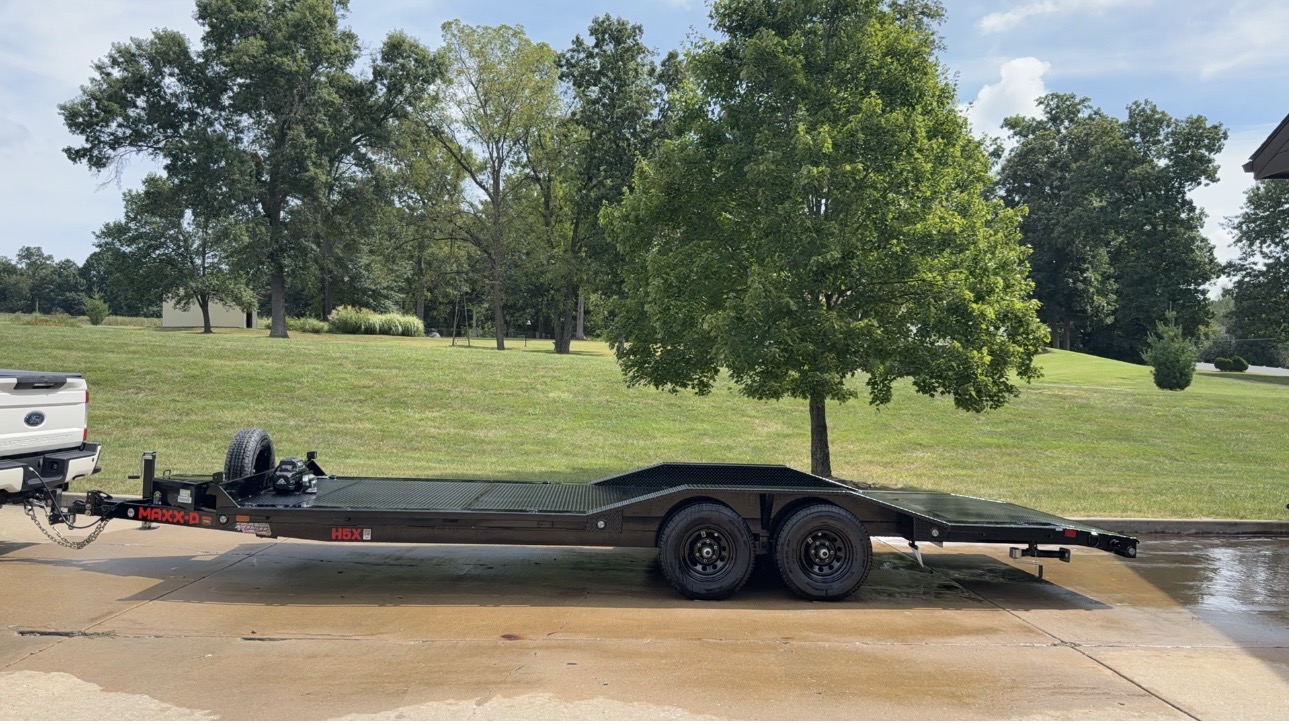
This is the checklist we would want every renter to go through, whether you are taking our 20' Spartan enclosed trailer or our 22' MAXX-D car hauler.
Step 1: Can your vehicle actually pull it?
Every truck and SUV has a maximum towing rating set by the manufacturer. You will find it in the owner's manual or on the manufacturer's website for your exact model, engine, and axle ratio. The driver's door jamb sticker lists related ratings, like how much weight your vehicle can carry.
What you are towing is the trailer plus everything on it. A car on a car hauler, or a trailer full of furniture, adds up quickly. As a rough rule, these trailers loaded are a job for a full-size pickup or a large body-on-frame SUV. Most crossovers and minivans are not rated for it.
Not sure? Text 314-866-0009 with your year, make, model, and engine, plus what you plan to haul. We will work through the numbers with you before you book, not at pickup.
Step 2: The right ball
Both of our trailers take a 2-5/16" ball. Many trucks come with a 2" ball, which looks almost the same. A 2" ball under a 2-5/16" coupler can latch and still pop loose on a bump. Look at the top of the ball, where the size and weight rating are stamped.
The ball mount should also put the trailer close to level when hooked up. A trailer with its nose pointed up or down handles worse and wears tires unevenly. If yours sits way off, you may need a mount with a different drop.
Step 3: Plug and brakes
Our trailers use a round 7-pin plug. Besides the lights, the 7-pin carries the signal for the trailer's brakes. That means:
- Your vehicle needs a 7-pin socket. Many trucks with a towing package have one by the hitch.
- Your vehicle needs a brake controller, either built in (many newer trucks have one on the dash) or added on.
- A 4-flat adapter will run the lights but not the brakes. That is not a safe way to stop a loaded trailer.
Step 4: Mirrors
The enclosed trailer is about 95 inches wide, wider than most pickups. If you cannot see down both sides of the trailer from the driver's seat, you need towing mirrors. Clip-on extensions are cheap and make lane changes on I-70 a lot less stressful.
Step 5: The walk-around
Firefighters call it a rig check. Before you pull out, walk all the way around the truck and trailer:
- Coupler latched and pinned over the ball. Lift up on the tongue jack a little to make sure it is truly seated.
- Safety chains crossed under the tongue in an X, hooked to the truck, with enough slack to turn but not dragging on the ground.
- Breakaway cable clipped to the truck itself, not to the safety chains. If the trailer ever came loose, this cable sets its brakes.
- Plug seated and the cord routed so it will not drag.
- Lights checked with a helper: running lights, brake lights, and both turn signals.
- Tongue jack all the way up.
- Tires look evenly inflated, with no bulges or cuts.
- Load secured, doors latched, ramp door or tilt deck locked.
- Test the brakes at low speed in the driveway or lot before you hit the road.
Step 6: At every stop
- Re-check straps. They loosen as the load settles, most often in the first few miles.
- Look over the coupler, chains, and plug again.
- Hold your hand near each wheel hub. Warm is normal. If one is much hotter than the others, or too hot to keep your hand near, do not keep driving. Call us.
Driving with a trailer around here
- Bridges and wind. The Missouri River bridges on I-70, Route 364, Route 370, and I-64 are exposed. A tall enclosed trailer gets pushed around in a crosswind. Slow down and stay off the edge of the lane.
- Construction zones. Narrowed lanes with concrete barriers leave little room for a 95-inch trailer. Stay centered and do not try to pass trucks there.
- Following distance. Leave at least double your normal gap. A loaded trailer needs a lot more room to stop.
- Turns. Swing wider than feels natural, especially in older neighborhoods with tight curbs.
- Backing. Put your hand at the bottom of the steering wheel. Move your hand the way you want the back of the trailer to go. Small inputs, and get out and look.
Never let anyone ride inside a trailer, and never tow with a ball that is the wrong size or rated below the trailer's weight. Those two shortcuts cause some of the worst towing accidents, and neither is worth it.
At pickup, we go through the hookup with you and answer anything this list did not cover. Questions before then? Call or text 314-866-0009.